
Before reciting the Quran, a Muslim does not begin as they would begin an ordinary text. Quran recitation is an act of worship that requires respect, concentration, sincerity and attention.
Among the first notions a learner encounters in recitation are isti‘adhah, seeking protection with Allah, and basmala, the formula “Bismi-Llahi r-Rahmani r-Rahim”.
These two formulas are often studied together because they relate to the beginning of Quran recitation. However, they have different meanings and specific rules of use, especially when starting a surah or connecting two surahs in recitation.
In this article, we will explain what isti‘adhah and basmala are, when to recite them, how to understand them, the rules related to beginning recitation and how to apply them gradually when learning the Quran.
Why learn the rules of beginning Quran recitation?
Learning to recite the Quran is not only about knowing Arabic letters or Tajweed rules. It also involves knowing some manners and rules related to how to begin and organize recitation.
Isti‘adhah and basmala are part of these important notions. They remind the reader that the Quran is the Word of Allah and that its recitation should be approached with humility, protection, concentration and respect.
For beginners, these rules also show that Quran recitation is based on precise transmission. The learner studies what to say, when to say it and how to connect formulas at the beginning or between surahs.
What is isti‘adhah?
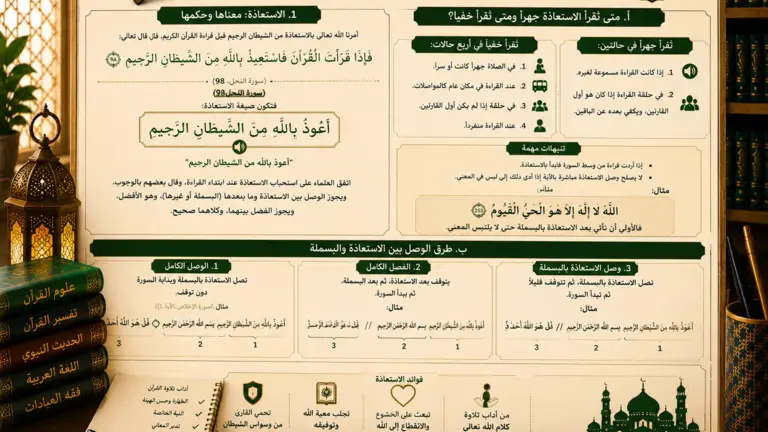
Isti‘adhah means seeking refuge and protection with Allah. In the context of Quran recitation, it means asking Allah to protect us from Satan before reading His words.
The most well-known formula is:
أَعُوذُ بِاللّٰهِ مِنَ الشَّيْطَانِ الرَّجِيمِ
It is usually transliterated as:
A‘udhu billahi min ash-shaytan ir-rajim.
In English, it means:
I seek refuge with Allah from Satan, the accursed.
This formula is short, but its meaning is deep. The believer recognizes weakness, need for Allah and the need for protection against whispers, distraction, pride and heedlessness.
The basis of isti‘adhah before reading the Quran
Isti‘adhah is connected to the verse in which Allah says:
فَإِذَا قَرَأْتَ الْقُرْآنَ فَاسْتَعِذْ بِاللّٰهِ مِنَ الشَّيْطَانِ الرَّجِيمِ
Meaning:
“So when you recite the Quran, seek refuge in Allah from Satan, the expelled.”
This verse shows that Quran recitation should begin with seeking protection. The reader does not rely only on memory, voice or knowledge. They turn first to Allah.
What does A‘udhu billahi min ash-shaytan ir-rajim mean?
Each part of the formula carries an important meaning:
- أَعُوذُ means: I seek refuge, I ask for protection.
- بِاللّٰهِ means: with Allah, by Allah.
- مِنَ الشَّيْطَانِ means: from Satan.
- الرَّجِيمِ means: the accursed, the rejected, the one distanced from Allah’s mercy.
Understanding this formula helps the student avoid reciting it mechanically. Isti‘adhah becomes an act of humility and awareness before entering Quran recitation.
When should isti‘adhah be recited?
The most well-known moment for reciting isti‘adhah is before reading or reciting the Quran. It prepares the heart and tongue to approach the words of Allah with respect and concentration.
When reading alone, a person may recite it quietly or aloud. In a group recitation, the first reader may recite it aloud, while others say it more quietly before their own recitation.
A Muslim may also seek refuge with Allah in other situations: when facing temptation, fear, anger, weakness or harmful whispers. However, this article focuses mainly on its use at the beginning of Quran recitation.
What is the basmala?
The basmala is the formula:
بِسْمِ اللّٰهِ الرَّحْمٰنِ الرَّحِيمِ
It is usually transliterated as:
Bismi-Llahi r-Rahmani r-Rahim.
In English, it means:
In the name of Allah, the Most Merciful, the Especially Merciful.
The basmala is a formula of beginning. It expresses that the believer begins the recitation in the name of Allah, seeking His blessing, help and mercy.
What is the difference between isti‘adhah and basmala?
Isti‘adhah and basmala are two important formulas, but they do not have the same meaning.
Isti‘adhah means seeking refuge with Allah from Satan. It prepares the reader by seeking protection against distractions and whispers.
Basmala means beginning in the name of Allah, the Most Merciful, the Especially Merciful. It opens recitation with remembrance, blessing and trust in Allah.
In summary:
- isti‘adhah is a request for protection;
- basmala is a formula of beginning in the name of Allah.
When is the basmala recited in the Quran?
The basmala is recited at the beginning of surahs, except for Surah At-Tawbah, which does not begin with the basmala in the Mushaf.
When a reader starts a surah from the beginning, they usually recite isti‘adhah, then basmala, then the beginning of the surah.
If the reader starts in the middle of a surah, they recite isti‘adhah. They may then recite or omit the basmala depending on the context of their recitation and what they have been taught.
Regarding Surah Al-Fatihah, there are jurisprudential details according to the schools. In the Shafi‘i school, for example, the basmala is considered part of Al-Fatihah. For detailed legal rulings, it is better to refer to qualified teachers.
Why does Surah At-Tawbah not begin with the basmala?
Surah At-Tawbah, also called Repentance, is the only surah in the Quran that does not begin with the basmala in the Mushaf.
When beginning Surah At-Tawbah from its start, the reader does not recite the basmala before the first verse. The reader may recite isti‘adhah before beginning, but does not place basmala at the start of this surah.
This is an important point in learning the rules of beginning recitation because it shows that basmala is not used identically in every case.
How should a surah be started?
When starting a surah from the beginning, the most well-known order is:
- recite isti‘adhah;
- recite basmala;
- begin the surah.
For example, before beginning a surah, the reader says:
أَعُوذُ بِاللّٰهِ مِنَ الشَّيْطَانِ الرَّجِيمِ
Then:
بِسْمِ اللّٰهِ الرَّحْمٰنِ الرَّحِيمِ
Then the reader recites the first verse of the surah.
This structure helps beginners organize their recitation and avoid confusion between the formulas.
The rules of basmala between two surahs
When the reader finishes one surah and begins the next, several ways of connecting the end of the first surah, the basmala and the beginning of the next surah are known in the study of recitation.
1. Complete separation
Complete separation means stopping at the end of the first surah, then reciting the basmala separately, then pausing before beginning the next surah.
In this case, the end of the surah, the basmala and the beginning of the next surah are separated by pauses.
2. Partial separation
Partial separation means stopping at the end of the first surah, then connecting the basmala to the first verse of the next surah.
This method is useful to know because it shows that the basmala may be connected to the beginning of the next surah after pausing at the end of the previous one.
3. Complete connection
Complete connection means connecting the end of the first surah to the basmala, then connecting the basmala to the beginning of the next surah without pausing.
This requires more mastery because the reader must maintain fluency while preserving clarity.
The connection to avoid
There is a form to avoid: connecting the end of a surah to the following basmala and then stopping on the basmala before beginning the next surah.
This is discouraged because it may give the impression that the basmala belongs to the end of the previous surah rather than introducing the next one.
The special case between Al-Anfal and At-Tawbah
Surah At-Tawbah does not begin with the basmala. For this reason, the rules of connection between Surah Al-Anfal and Surah At-Tawbah are particular.
The reader may stop at the end of Al-Anfal and then begin At-Tawbah without basmala. The reader may also connect the end of Al-Anfal directly to the beginning of At-Tawbah according to the rules studied with a teacher.
Partial connection with basmala is not possible here because there is no basmala at the beginning of Surah At-Tawbah.
Isti‘adhah, basmala and Tajweed: how are they connected?
Isti‘adhah and basmala are not Tajweed rules in the same sense as madd, ghunnah or makharij. They are more closely related to the manners and rules of beginning recitation.
However, they are often studied in recitation and Tajweed classes because they show how to begin Quran reading correctly and how to connect surahs.
A student learning Tajweed should therefore know these formulas, their meanings and their place in recitation, even though learning them does not replace the study of pronunciation rules.
Common mistakes to avoid
Beginners may make several mistakes when learning isti‘adhah and basmala.
- Confusing the meaning of isti‘adhah and basmala.
- Reciting basmala at the beginning of Surah At-Tawbah.
- Forgetting isti‘adhah before beginning Quran reading.
- Connecting the end of a surah to the next basmala and then stopping.
- Pronouncing the formulas without understanding their meanings.
- Reciting too quickly without articulating the letters clearly.
- Relying only on transliteration.
These mistakes can be corrected through listening, repetition, gradual study of the rules and recitation to a competent person.
How to learn these rules effectively
To learn isti‘adhah, basmala and the rules of beginning recitation, a simple method is useful:
- memorize both formulas in Arabic;
- understand their meanings in English;
- listen to their correct pronunciation;
- recite them slowly;
- learn when to use them;
- practice starting different surahs;
- study connection rules between two surahs;
- receive correction from a teacher if possible.
This progression helps the learner move from simple memorization to more conscious and better organized recitation.
Learning Quran recitation with method
Isti‘adhah and basmala are among the first formulas encountered by many students learning Quran recitation. They connect Arabic language, belief, recitation and the manners of reading the Quran.
To go further in practice, it is useful to learn Arabic letters, pronunciation, Tajweed rules, pauses, elongations and oral correction.
You can read our pillar article on Tajweed, its definition and essential rules to understand the general foundations before studying each topic in more detail.
For structured support, our online Tajweed courses help students work on recitation with oral correction and adapted progression.
If you want to understand the Arabic words used in recitation, Quranic Arabic courses can also complete your learning.
Book your free trial of 30 minutes
Registration form
FAQ — Isti‘adhah and Basmala
What does isti‘adhah mean?
Isti‘adhah means seeking refuge and protection with Allah, especially from Satan and his whispers.
What is the formula of isti‘adhah?
The known formula is: أَعُوذُ بِاللّٰهِ مِنَ الشَّيْطَانِ الرَّجِيمِ, transliterated A‘udhu billahi min ash-shaytan ir-rajim.
What does basmala mean?
The basmala is the formula: بِسْمِ اللّٰهِ الرَّحْمٰنِ الرَّحِيمِ. It means: “In the name of Allah, the Most Merciful, the Especially Merciful.”
What is the difference between isti‘adhah and basmala?
Isti‘adhah is a request for protection with Allah from Satan. Basmala is a formula of beginning in the name of Allah.
Should basmala be recited at the beginning of every surah?
Basmala is recited at the beginning of surahs, except at the beginning of Surah At-Tawbah, which does not begin with basmala in the Mushaf.
Can basmala be recited in the middle of a surah?
If the reader begins in the middle of a surah, they recite isti‘adhah. They may recite or omit basmala depending on the context of recitation and what they have been taught.
Is isti‘adhah part of Tajweed?
Isti‘adhah is connected to the manners of beginning recitation. It is often studied with basmala in recitation and Tajweed classes.
Conclusion: beginning recitation with protection and awareness
Isti‘adhah and basmala are two essential formulas for understanding how to begin Quran recitation. Isti‘adhah reminds the reader to seek refuge with Allah from Satan, while basmala opens recitation in the name of Allah, the Most Merciful, the Especially Merciful.
Learning these formulas is not only about repeating them. The learner should also understand their meanings, their place in recitation and the rules connected to the beginning of surahs or the connection between two surahs.
With a progressive method, listening and guidance from a teacher, the student can recite these formulas correctly and begin Quran reading with more respect, clarity and presence of heart.





No Comments
No comments yet.
No comments yet.