
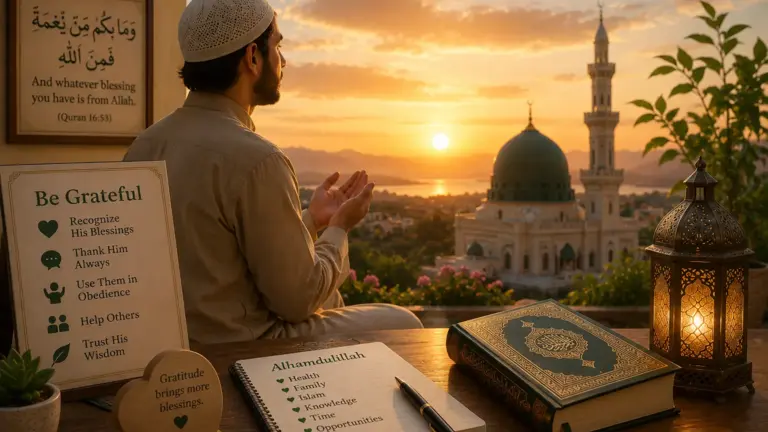
Gratitude is one of the essential qualities of a Muslim. In Islam, being grateful is not limited to saying “thank you”. It is a way of recognizing Allah’s blessings, using them in what pleases Him and living with humility before the One who gives everything.
Every breath, every moment of health, every family relationship, every opportunity to learn and every act of guidance is a blessing from Allah. Some blessings are obvious, while others remain hidden from us. A believer learns to recognize both.
In this article, we will explain the meaning of gratitude in Islam, what shukr means, how to thank Allah with the heart, the tongue and actions, and how Islamic knowledge helps the believer live with more awareness and thankfulness.
What Is Gratitude in Islam?
Gratitude in Islam is called shukr. It means recognizing Allah’s blessings, acknowledging that they come from Him, and using those blessings in a way that pleases Him.
Shukr is not only an emotion. It is also a form of worship. A person may feel thankful, but true gratitude should also appear in speech, choices, priorities and behavior.
A grateful Muslim understands that nothing is truly independent from Allah. Wealth, health, knowledge, time, family, security, food, guidance and faith are all gifts from Him.
Why Is Shukr So Important?
Shukr is closely connected to faith. The believer does not see blessings as random events or as the result of personal effort alone. The believer sees them as signs of Allah’s mercy, generosity and wisdom.
Gratitude protects the heart from arrogance. When a person remembers that every blessing comes from Allah, they become more humble. They are less likely to boast, look down on others or think that success belongs only to themselves.
Gratitude also protects the heart from constant dissatisfaction. A person who only looks at what is missing may forget what Allah has already given. Shukr teaches balance: working for what is good, while recognizing the blessings already present.
Recognizing the Blessings of Allah
The blessings of Allah cannot be fully counted. Some are visible, such as food, shelter, family, health and safety. Others are less visible, such as protection from harm, guidance, peace of heart, good advice, useful knowledge and the ability to worship.
Among the greatest blessings is Islam itself. Guidance to faith, the Quran, prayer, repentance, dua and the Sunnah of the Prophet ﷺ are gifts that give meaning to life and direction to the heart.
A Muslim should pause regularly and reflect: what has Allah given me? What has He protected me from? Which doors has He opened? Which blessings have I become used to and stopped noticing?
The Three Forms of Gratitude in Islam
Scholars often explain gratitude through three main dimensions: the heart, the tongue and the actions.
Gratitude of the heart
Gratitude of the heart means recognizing inwardly that blessings come from Allah. The heart does not become proud, attached only to material causes or blind to the Giver.
This inward recognition creates humility, love for Allah and awareness of dependence upon Him.
Gratitude of the tongue
Gratitude of the tongue includes praising Allah, saying alhamdulillah, making dua and mentioning Allah’s favors with the right intention.
A Muslim should also use the tongue in ways that reflect gratitude: speaking truthfully, avoiding harmful speech, thanking people for their kindness and using words to encourage what is good.
Gratitude through actions
True gratitude appears in actions. A person thanks Allah for health by using the body in obedience, not in disobedience. They thank Allah for wealth by spending lawfully and giving in charity. They thank Allah for knowledge by acting upon it and sharing benefit.
Using a blessing in what displeases Allah is a form of ingratitude. This is why shukr is not only about words, but about how a person lives.
Does Gratitude Increase Blessings?
The Quran teaches that gratitude is connected to increase. This increase may appear in different ways: more blessings, more benefit, more contentment, more barakah or better use of what a person already has.
However, gratitude should not be treated as a transaction where a person thanks Allah only to receive more worldly gain. A Muslim is grateful because Allah deserves to be thanked.
When Allah increases a grateful person, He may increase wealth, guidance, peace, knowledge, usefulness, family harmony or protection from harm. The forms of increase belong to His wisdom.
How to Thank Allah in Daily Life
Gratitude becomes stronger when it is practiced daily. Here are simple ways to thank Allah:
- say alhamdulillah with attention and sincerity;
- remember Allah’s blessings before complaining;
- use your time in what benefits your religion and your life;
- pray with humility and consistency;
- give charity according to your means;
- thank people for the good they do;
- avoid using blessings in sinful actions;
- teach children to recognize Allah’s favors;
- ask Allah to make you among the grateful.
Small habits can transform the way a person sees life. Gratitude does not remove all hardship, but it changes how the heart receives both ease and difficulty.
What Gratitude Is Not
Gratitude does not mean denying pain, injustice or difficulty. A Muslim can be grateful while also feeling sadness, seeking help, solving problems and asking Allah for relief.
Gratitude also does not mean comparing oneself to others in a way that creates pride or guilt. It means recognizing Allah’s favors with humility and using them responsibly.
A grateful believer does not ignore hardship, but does not allow hardship to erase every blessing from the heart.
Learning Islam to Live with Thankfulness
Gratitude is connected to many foundations of Islam: belief in Allah, prayer, dua, patience, barakah, lawful income, family rights, good manners and the Quran.
To understand shukr properly, it is useful to learn Islam step by step with reliable sources and qualified teachers. Islamic knowledge helps a believer distinguish between real gratitude, empty words and habits that weaken the heart.
If you want to learn Islam with a clear and progressive approach, Al-Dirassa offers courses adapted to beginners, adults and families.
You can also study Islamic studies online, read more Islamic articles, or strengthen your connection with revelation through our online Quran and Tajweed classes.
Book your free trial of 30 minutes
Registration form
Conclusion
Gratitude in Islam, or shukr, means recognizing Allah’s blessings, thanking Him and using those blessings in what pleases Him. It is expressed through the heart, the tongue and actions.
A grateful Muslim sees blessings with humility, says alhamdulillah sincerely and tries to live in obedience to Allah. Gratitude brings balance to the heart and helps the believer face both ease and hardship with faith.
Understanding gratitude is a first step. To live Islam more completely, a person needs method, regularity, reliable sources and guidance from a qualified teacher.

No Comments
No comments yet.
No comments yet.