
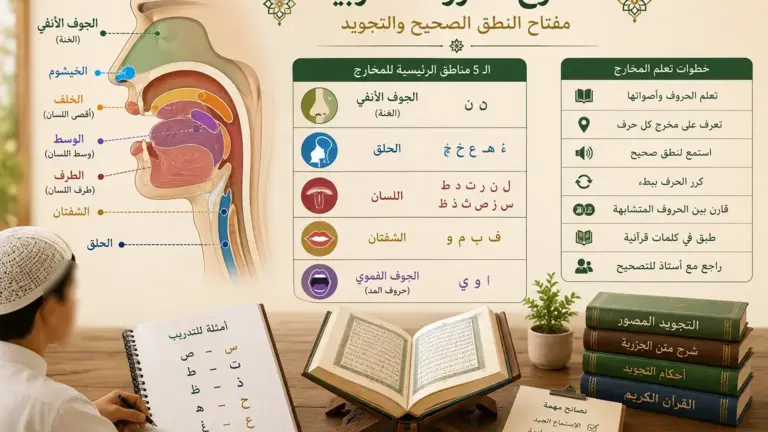
The articulation points of Arabic letters, known as Makharij al-Huruf, are essential in learning Arabic pronunciation and Tajweed. They refer to the precise places from which letters are produced when pronounced.
To recite the Quran correctly, it is not enough to recognize Arabic letters. The learner must also know how to produce them using the mouth, tongue, throat, lips or nasal cavity. This precision helps avoid confusion between similar letters and improves the clarity of recitation.
In this article, we will explain what makharij are, why they matter in Tajweed, the main articulation zones of Arabic letters, common mistakes to avoid and how to learn them progressively.
What does Makharij al-Huruf mean?
The word makharij is the plural of makhraj. It means the exit point of a letter. The expression Makharij al-Huruf therefore means the articulation points of letters.
Each Arabic letter has a specific articulation point or production zone. Some letters come from the throat, others from the tongue, lips, oral cavity or nasal cavity.
Knowing these points helps the learner pronounce letters more precisely. It is an important foundation for studying Tajweed and for correct Quran recitation.
Why are makharij important in Tajweed?
Tajweed teaches the correct way to recite the Quran. Makharij help the learner respect Arabic letters and avoid pronunciation mistakes.
Some letters may seem close to non-Arabic speakers, such as س and ص, ت and ط, or ذ and ظ. However, they are not pronounced in the same way and do not always come from the same place.
Working on articulation points therefore helps distinguish letters, improve recitation and read the Quran with greater attention.
This foundation is especially important for beginners. Repeated incorrect pronunciation can become a habit that is difficult to correct. It is better to learn letters with their articulation points from the beginning.
What is the difference between makhraj and sifah?
In Tajweed, makharij and sifat are connected, but they do not mean exactly the same thing.
The makhraj indicates the origin of the sound: where the letter comes from. For example, a letter may come from the throat, tongue or lips.
The sifah, or characteristic of the letter, describes how the letter is pronounced: strength, softness, emphasis, lightness, breath, bounce or another feature.
In other words, makhraj indicates where the letter is produced, while sifah indicates how it is pronounced. Both are needed for correct recitation.
How can you identify the articulation point of an Arabic letter?
A classical method consists of placing a sukoon on the letter being studied, then preceding it with a hamzah carrying a vowel. This makes it easier to hear the exit point of the letter.
For example, to hear the sound of an isolated letter, one may use forms such as:
- إِبْ to hear the letter ب;
- إِسْ to hear the letter س;
- إِقْ to hear the letter ق.
This method helps the learner isolate the sound, feel where it comes from and compare similar letters.
The 5 main articulation zones of Arabic letters
Scholars of Tajweed generally group Arabic letter articulation points into five main zones:
- the oral cavity — الجوف;
- the throat — الحلق;
- the tongue — اللسان;
- the lips — الشفتان;
- the nasal cavity — الخيشوم.
These five zones help the learner understand how Arabic sounds are produced and how letters differ from one another.
1. The oral cavity — الجوف
The oral cavity refers to the empty space that produces elongated sounds. It is connected to the letters of elongation, known as Madd letters.
The letters concerned are:
- ا when the previous letter has fathah;
- و when it has sukoon and the previous letter has dammah;
- ي when it has sukoon and the previous letter has kasrah.
These letters are not produced like ordinary consonants. They require proper control of duration, breath and fluency.
Frequent Quranic examples include:
- إِيَّاكَ;
- الْمَغْضُوبِ;
- يَوْمِ الدِّينِ;
- الَّذِينَ.
Mastering the oral cavity helps respect elongations and avoid shortening sounds that should be lengthened.
2. The throat — الحلق
The throat is an important zone for several Arabic letters. It includes three articulation levels:
- the lower throat;
- the middle throat;
- the upper throat.
The six letters generally connected to the throat are:
- ء;
- ه;
- ع;
- ح;
- غ;
- خ.
These letters may be difficult for non-Arabic speakers because some of these sounds do not exist in their language. Many learners confuse ح and ه, or pronounce ع like a simple vowel.
To learn them correctly, the student needs to listen to reliable pronunciation, repeat slowly and receive correction whenever possible.
3. The tongue — اللسان
The tongue is the most used articulation zone. Many Arabic letters are produced with different parts of the tongue: its back, middle, sides or tip.
It is also the zone where many confusions appear among beginners because several letters have close articulation points.
The back of the tongue: ق and ك
The letters ق and ك are produced with the back of the tongue, but they are not pronounced in exactly the same place.
The letter ق is produced deeper, with the back of the tongue touching the upper palate. It is a deeper sound.
The letter ك is also produced with the back of the tongue, but its contact point is slightly more forward.
Confusing these two letters can change the meaning of words. This is why they should be practiced carefully.
The middle of the tongue: ش, ج and ي
The letters ش, ج and ي are connected to the middle of the tongue. The middle part of the tongue comes close to the upper palate to produce these sounds.
These letters require clear articulation, especially when they appear in short Quranic words or frequently recited passages.
The sides of the tongue: ض and ل
Some letters are produced with the sides of the tongue. The letter ض is especially known for its difficulty. It requires contact between the side of the tongue and the upper molars.
The letter ل also involves contact between part of the tongue and the area near the upper teeth. It must be distinguished from neighboring letters.
The letter ض is one of the most difficult letters for non-Arabic speakers. It often requires oral correction.
The tip of the tongue: ن and ر
The letters ن and ر are produced with the tip of the tongue, but they are not pronounced in the same way.
The letter ن is accompanied by nasal output in some situations. The letter ر requires precise articulation to avoid a sound that is too rolled, too weak or too close to another letter.
The letters ت, د and ط
The letters ت, د and ط have close articulation points. They are produced with the tip of the tongue near the upper teeth.
The letter ط is emphatic and deeper than ت and د. Many beginners pronounce ط like a simple ت, which weakens recitation.
The letters س, ز and ص
The letters س, ز and ص are also close. They require good control of airflow between the tongue and the teeth.
The letter ص is emphatic, unlike س. It must therefore be clearly distinguished. The letter ز is voiced, which differentiates it from س.
The letters ث, ذ and ظ
The letters ث, ذ and ظ are pronounced with the tip of the tongue touching or approaching the upper incisors.
The letter ظ is emphatic, unlike ث and ذ. It therefore requires deeper and more marked articulation.
These three letters are often difficult for non-Arabic speakers because they do not naturally exist in many languages.
4. The lips — الشفتان
The lips produce several important letters. The position, closing and release of the lips directly influence the clarity of these sounds.
The main letters connected to the lips are:
- ف;
- ب;
- م;
- و when it is not the waw of elongation.
The letter ف is produced with the lower lip and the upper incisors. The letters ب and م involve both lips. The letter و requires rounding of the lips.
Incorrect closing or release may change the pronunciation, especially between ب and م.
5. The nasal cavity — الخيشوم
The nasal cavity is connected to ghunnah, a nasal sound found in some Tajweed rules.
Ghunnah appears especially with م and ن in certain situations, particularly when they carry shaddah:
- مّ;
- نّ.
Examples:
- عَمَّ;
- ثُمَّ;
- جَنَّاتٍ;
- إِنَّ.
Ghunnah is not produced with the tongue. It comes from the nasal cavity and requires correct duration. It should be heard without being omitted or exaggerated.
Summary table of the main articulation zones
| Articulation zone | Arabic name | Letters or sounds concerned | Common difficulty |
|---|---|---|---|
| Oral cavity | الجوف | ا، و، ي as Madd letters | Not respecting elongation duration |
| Throat | الحلق | ء، ه، ع، ح، غ، خ | Confusing throat letters |
| Tongue | اللسان | ق، ك، ج، ش، ي، ض، ل، ن، ر، ت، د، ط، س، ز، ص، ث، ذ، ظ | Confusing close or emphatic letters |
| Lips | الشفتان | ف، ب، م، و | Incorrect lip closing or rounding |
| Nasal cavity | الخيشوم | Ghunnah with م and ن | Omitting or exaggerating nasalization |
Common pronunciation mistakes
Beginners often face difficulties when learning the articulation points of Arabic letters. These mistakes are normal at first, but they should be corrected gradually.
- Confusing emphatic and non-emphatic letters.
- Pronouncing ع like a simple vowel.
- Confusing ح and ه.
- Not distinguishing س and ص.
- Pronouncing ط like ت.
- Confusing ذ, ز and ظ.
- Neglecting ghunnah.
- Reading too quickly without respecting sounds.
- Depending only on transliteration.
These mistakes can be corrected through listening, repetition, slow reading and adapted correction.
How to learn makharij correctly
To learn makharij, the student should move step by step. It is better to begin with the most frequent letters, then work on difficult letters with simple examples.
A useful method is to:
- learn Arabic letters and their sounds;
- identify the articulation zone of each letter;
- listen to correct pronunciation;
- repeat each letter slowly;
- compare similar letters;
- apply the sounds in Quranic words;
- recite to a teacher for correction.
Beginners who do not yet know the letters can start with a free Arabic alphabet course.
Why learning with a teacher can help
Makharij are practical. Reading an explanation may help, but it is not always enough to correct pronunciation.
A teacher can listen to the student, identify mistakes, show the correct articulation and provide adapted exercises. This support is especially useful for difficult letters and Tajweed rules applied to recitation.
To work on pronunciation in recitation, you can discover our online Tajweed courses. For a broader approach to reading and recitation, our online Quran courses also help students progress with a qualified teacher.
Students who want to better understand the vocabulary and language of the Quran can also study Quranic Arabic.
Book your free trial of 30 minutes
Registration form
FAQ — Makharij al-Huruf
What does Makharij al-Huruf mean?
Makharij al-Huruf means the articulation points of letters. These are the places from which Arabic letters are produced when pronounced.
How many main articulation zones are there?
There are generally five main zones: the oral cavity, throat, tongue, lips and nasal cavity.
Why are makharij important in Tajweed?
They help pronounce letters correctly, avoid confusion between similar letters and recite the Quran with more precision.
What is the difference between makhraj and sifah?
The makhraj shows where the letter comes from. The sifah describes the characteristic of the letter, meaning how it is pronounced.
Which Arabic letters are difficult for non-Arabic speakers?
Throat letters such as ع, ح, غ and خ, as well as emphatic letters such as ص, ض, ط and ظ, often require special practice.
Can you learn makharij alone?
You can understand the basics alone, but correction from a teacher is very useful to hear and fix pronunciation mistakes.
Conclusion: better pronunciation for better recitation
The articulation points of Arabic letters are an essential foundation for improving pronunciation, Tajweed and Quran recitation. They help distinguish letters, avoid confusion and recite with greater precision.
Learning makharij requires patience. The student needs to listen, repeat, correct and apply sounds in real words and verses.
With a progressive method and the help of a teacher when possible, every learner can improve Arabic pronunciation and move toward clearer, more correct and more attentive recitation.





No Comments
No comments yet.
No comments yet.