
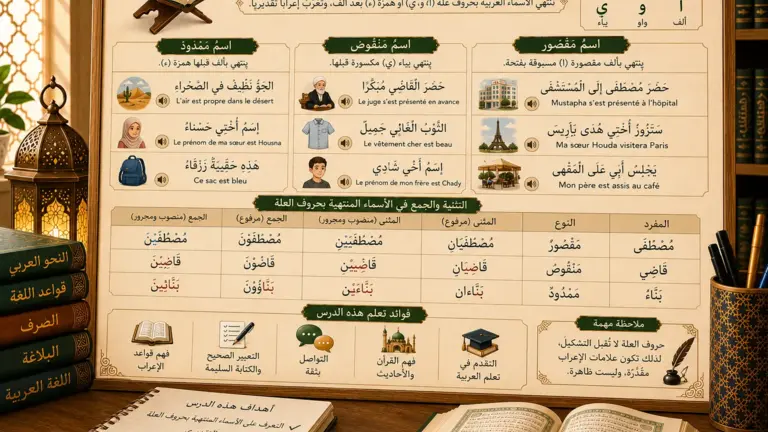
When learning Arabic grammar, some nouns have special endings. This is the case with maqṣūr, manqūṣ and mamdūd nouns. These three categories are important for understanding Arabic declension, correct reading and sentence analysis.
In Arabic, these nouns are called:
- الاسْمُ المَقْصُورُ: the maqṣūr noun;
- الاسْمُ المَنْقُوصُ: the manqūṣ noun;
- الاسْمُ المَمْدُودُ: the mamdūd noun.
This lesson is designed for beginner Arabic students, but also for learners who want to strengthen their Arabic grammar, Arabic reading, Classical Arabic, Modern Standard Arabic or Quranic Arabic.
Understanding these three types of nouns helps students recognize endings, understand grammatical cases and analyze Arabic sentences more accurately.
Weak letters in Arabic
In Arabic, certain letters are called weak letters. They are:
- ا: alif;
- و: wāw;
- ي: yā.
These letters play an important role in Arabic grammar because they can affect pronunciation, spelling and declension.
Maqṣūr and manqūṣ nouns are directly related to these weak letters. A maqṣūr noun ends with alif maqṣūrah, while a manqūṣ noun ends with a yā preceded by a kasrah.
Why do some nouns have special declension?
In Arabic, a noun can be nominative, accusative or genitive. These cases are usually indicated by signs such as ḍammah, fatḥah or kasrah.
However, when a noun ends with a weak letter or a special hamzah, these signs are not always visible. This is called estimated or virtual declension, known in Arabic as:
إِعْرَابٌ تَقْدِيرِيٌّ
This means that the grammatical sign exists in analysis, even if it is not necessarily visible or pronounced at the end of the word.
Comparison table of maqṣūr, manqūṣ and mamdūd nouns
| Type of noun | Arabic name | Ending | Example | Main feature |
|---|---|---|---|---|
| Maqṣūr noun | اسْمٌ مَقْصُورٌ | Alif maqṣūrah ى | مُصْطَفَى | Estimated declension signs |
| Manqūṣ noun | اسْمٌ مَنْقُوصٌ | Yā preceded by kasrah | الْقَاضِي | The final yā may be kept or removed |
| Mamdūd noun | اسْمٌ مَمْدُودٌ | Hamzah preceded by long alif | صَحْرَاءُ | Declension depends on masculine or feminine form |
The maqṣūr noun in Arabic
The maqṣūr noun, called اسْمٌ مَقْصُورٌ, is a declinable noun ending with alif maqṣūrah, usually written ى. The letter before this alif carries a fatḥah.
Examples:
- مُصْطَفَى: Mustafa;
- مُرْتَضَى: Murtada;
- سَلْمَى: Salma;
- لَيْلَى: Layla;
- مُوسَى: Musa;
- هُدَى: Huda;
- مَأْوَى: refuge, shelter;
- الْمُسْتَشْفَى: the hospital;
- الْمَقْهَى: the café.
How to recognize a maqṣūr noun
To recognize a maqṣūr noun, three conditions must be met:
- the word must be a noun;
- it must be declinable, meaning اسْمٌ مُعْرَبٌ;
- it must end with alif maqṣūrah preceded by a fatḥah.
Some words end with ى, but they are not maqṣūr nouns. For example, عَلَى is not a maqṣūr noun because it is a preposition. Similarly, يَسْعَى is not a maqṣūr noun because it is a verb.
Declension of the maqṣūr noun
A maqṣūr noun can be nominative, accusative or genitive. In all three cases, the declension sign is estimated, because it cannot appear clearly on the final alif.
| Case | Arabic example | Translation | Declension sign |
|---|---|---|---|
| Nominative | حَضَرَ مُرْتَضَى الاجْتِمَاعَ | Murtada attended the meeting. | Estimated ḍammah |
| Accusative | رَأَيْتُ مُرْتَضَى فِي الْمَدْرَسَةِ | I saw Murtada at school. | Estimated fatḥah |
| Genitive | ذَهَبْتُ مَعَ مُرْتَضَى إِلَى النَّادِي | I went with Murtada to the club. | Estimated kasrah |
In these three examples, the word مُرْتَضَى keeps the same form. Yet its grammatical function changes according to the sentence.
Examples of maqṣūr nouns in sentences
| Arabic example | Translation | Maqṣūr noun |
|---|---|---|
| نَامَتْ سَلْمَى مُبَكِّرَةً | Salma slept early. | سَلْمَى |
| هَذِهِ أُخْتِي لَيْلَى | This is my sister Layla. | لَيْلَى |
| الْبَيْتُ هُوَ مَأْوَى الأُسْرَةِ | The house is the family’s shelter. | مَأْوَى |
| اِسْمُ أَخِي مُوسَى | My brother’s name is Musa. | مُوسَى |
Summary table of the maqṣūr noun
| Element | Explanation |
|---|---|
| Arabic name | الاسْمُ المَقْصُورُ |
| Ending | Alif maqṣūrah ى |
| Condition | The word must be a declinable noun |
| Declension | The signs are estimated in all three cases |
| Grammatical term | إِعْرَابٌ تَقْدِيرِيٌّ |
The manqūṣ noun in Arabic
The manqūṣ noun, called اسْمٌ مَنْقُوصٌ, is a declinable noun ending with the letter ي, called yā, preceded by a kasrah. It often ends with a long -ī sound.
Examples:
- قَاضِي: judge;
- الْقَاضِي: the judge;
- سَاعِي: one who seeks or strives;
- غَالِي: dear, precious;
- نَادِي: club;
- شَادِي: Shadi.
This rule concerns Arabic nouns that end with a yā preceded by a kasrah. It is close to some rules studied with the maqṣūr noun, but the behavior of the final letter is different.
Why is the manqūṣ noun special?
The manqūṣ noun is special because declension signs are not always visible at the end of the word.
With the manqūṣ noun:
- the fatḥah generally appears in the accusative case;
- the ḍammah in the nominative case is often estimated;
- the kasrah in the genitive case is often estimated;
- the final yā may be kept or removed depending on the context.
Declension of the manqūṣ noun
The manqūṣ noun is declined according to its grammatical function in the sentence. Here are the three main cases:
| Case | Arabic example | Translation | Note |
|---|---|---|---|
| Nominative | جَاءَ قَاضِي الْمَدِينَةِ | The city judge came. | The ḍammah is estimated. |
| Accusative | رَأَيْتُ قَاضِيَ الْمَدِينَةِ | I saw the city judge. | The fatḥah appears. |
| Genitive | هَذَا بَيْتُ الْقَاضِي | This is the judge’s house. | The kasrah is estimated. |
When is the yā kept in the manqūṣ noun?
The letter ي of the manqūṣ noun is kept in several important situations.
When the noun is defined by ال
جَاءَ الْقَاضِي
The judge came.
When the manqūṣ noun is preceded by the definite article ال, the yā is kept.
When the noun is in annexation
جَاءَ قَاضِي الْمَدِينَةِ
The city judge came.
The yā is also kept when the manqūṣ noun is in annexation, meaning when it is مُضَافٌ.
When the noun is accusative
رَأَيْتُ قَاضِيًا
I saw a judge.
In the accusative case, the fatḥah appears and the yā is generally kept.
When is the yā removed?
In some cases, the final letter ي of the manqūṣ noun is removed. This happens when the noun is indefinite, not in annexation and not in the accusative case.
| Case | Arabic form | Translation | Explanation |
|---|---|---|---|
| Nominative | هَذَا قَاضٍ | This is a judge. | The yā is removed. |
| Genitive | مَرَرْتُ بِنَادٍ كَبِيرٍ | I passed by a big club. | The yā is removed. |
| Accusative | رَأَى أَخِي نَادِيًا كَبِيرًا | My brother saw a big club. | The yā is kept. |
Summary table of the manqūṣ noun
| Situation | Nominative | Accusative | Genitive |
|---|---|---|---|
| Defined by ال | الْقَاضِي | الْقَاضِيَ | الْقَاضِي |
| In annexation | قَاضِي الْمَدِينَةِ | قَاضِيَ الْمَدِينَةِ | قَاضِي الْمَدِينَةِ |
| Indefinite, not in annexation | قَاضٍ | قَاضِيًا | قَاضٍ |
The mamdūd noun in Arabic
The mamdūd noun, called اسْمٌ مَمْدُودٌ, is a singular noun ending with a hamzah ء preceded by a long alif ا.
In other words, its ending usually takes the following form:
ـاء
The word must be singular. Some words such as نِسَاءٌ, أَهْوَاءٌ or آبَاءٌ also end with ـاء, but they are not considered mamdūd nouns in this rule because they are plurals.
Examples of mamdūd nouns
| Mamdūd noun | Transliteration | Meaning |
|---|---|---|
| صَحْرَاءُ | ṣaḥrāʾu | desert |
| بَيْضَاءُ | bayḍāʾu | white, feminine |
| حَسْنَاءُ | ḥasnāʾu | beautiful woman |
| خَضْرَاءُ | khaḍrāʾu | green, feminine |
| بَنَّاءٌ | bannāʾun | builder |
| قَرَّاءٌ | qarrāʾun | reciter |
These examples show that the mamdūd noun can be masculine or feminine. This distinction is important because it affects its declension.
The hamzah in the mamdūd noun
The mamdūd noun ends with a hamzah ء. This hamzah comes after a long alif. It is not a weak letter like ا, و or ي, but it has a special behavior in some words.
For students learning Arabic online, this rule is useful for improving Arabic reading and pronunciation. It also helps distinguish different noun forms in texts.
Declension of the masculine mamdūd noun
When the mamdūd noun is masculine, it generally declines like an ordinary singular noun. The three declension signs can appear:
- ḍammah in the nominative case;
- fatḥah in the accusative case;
- kasrah in the genitive case.
| Case | Arabic example | Translation | Sign |
|---|---|---|---|
| Nominative | هَذَا قَرَّاءٌ لِلْقُرْآنِ | This is a reciter of the Quran. | ḍammah |
| Accusative | أُحِبُّ قَرَّاءَ الْقُرْآنِ | I love the reciter of the Quran. | fatḥah |
| Genitive | عَمِلْتُ مَعَ بَنَّاءٍ جَيِّدٍ | I worked with a good builder. | kasrah |
In these examples, قَرَّاءٌ and بَنَّاءٍ are masculine mamdūd nouns. They therefore follow regular declension.
Declension of the feminine mamdūd noun
When the mamdūd noun is feminine, such as صَحْرَاءُ, خَضْرَاءُ or بَيْضَاءُ, it contains what is called أَلِفُ التَّأْنِيثِ المَمْدُودَةُ, the long feminine alif.
In this case, the noun is often diptote, called مَمْنُوعٌ مِنَ الصَّرْفِ in Arabic. This means that it does not receive all the usual declension marks.
For this type of noun:
- the nominative usually takes a ḍammah;
- the accusative takes a fatḥah;
- the genitive also takes a fatḥah, except in certain cases.
| Case | Arabic example | Translation | Sign |
|---|---|---|---|
| Nominative | حَضَرَتْ حَسْنَاءُ الاِجْتِمَاعَ | Hasna attended the meeting. | ḍammah |
| Accusative | رَأَيْتُ الصَّحْرَاءَ الْغَرْبِيَةَ | I saw the western desert. | fatḥah |
| Genitive | ذَهَبْتُ بِأَثْوَابٍ بَيْضَاءَ | I left with white clothes. | fatḥah |
When does the feminine mamdūd noun take a kasrah?
Like other diptotes, the feminine mamdūd noun can take a kasrah in the genitive case in certain situations. This happens especially when it is preceded by the definite article ال or when it is in annexation, meaning in an إِضَافَة construction.
| Situation | Arabic example | Translation | Sign |
|---|---|---|---|
| With the definite article | عِنْدِي كَثِيرٌ مِنَ الأَثْوَابِ البَيْضَاءِ | I have many white clothes. | kasrah |
| In annexation | تَجَوَّلْتُ فِي صَحْرَاءِ السُّعُودِيَّةِ | I walked in the desert of Saudi Arabia. | kasrah |
Summary table of the mamdūd noun
| Type of mamdūd noun | Example | Nominative | Accusative | Genitive |
|---|---|---|---|---|
| Masculine | بَنَّاءٌ | ḍammah | fatḥah | kasrah |
| Feminine diptote | صَحْرَاءُ | ḍammah | fatḥah | fatḥah |
| Feminine with ال or in annexation | الصَّحْرَاءِ | ḍammah | fatḥah | kasrah |
Dual and plural forms of maqṣūr, manqūṣ and mamdūd nouns
These three categories of nouns can also have dual and plural forms. Their endings change according to the type of noun and the grammatical case.
| Type | Singular | Dual nominative | Dual accusative/genitive | Plural nominative | Plural accusative/genitive |
|---|---|---|---|---|---|
| Maqṣūr | مُصْطَفَى | مُصْطَفَيَانِ | مُصْطَفَيَيْنِ | مُصْطَفَوْنَ | مُصْطَفَيْنَ |
| Manqūṣ | قَاضِي | قَاضِيَانِ | قَاضِيَيْنِ | قَاضُونَ | قَاضِينَ |
| Mamdūd | بَنَّاءٌ | بَنَّاءَانِ | بَنَّاءَيْنِ | بَنَّاؤُونَ | بَنَّائِينَ |
Main differences between maqṣūr, manqūṣ and mamdūd nouns
| Question | Maqṣūr | Manqūṣ | Mamdūd |
|---|---|---|---|
| How does the word end? | With ى | With ي preceded by kasrah | With ء preceded by long alif |
| Are the signs visible? | No, they are estimated | Partly visible | Often visible, except special cases |
| Example | مُوسَى | الْقَاضِي | صَحْرَاءُ |
| Difficult point | Virtual declension | Keeping or removing the yā | Regular masculine or feminine diptote |
Common mistakes to avoid
- confusing every word ending in ى with a maqṣūr noun, even when it is a preposition or a verb;
- forgetting that the signs of the maqṣūr noun are estimated in all three cases;
- removing the yā of a manqūṣ noun when it is defined by ال;
- removing the yā of a manqūṣ noun in the accusative case;
- considering every word ending in ـاء to be mamdūd, even when it is plural;
- forgetting that some feminine mamdūd nouns are diptotes;
- using kasrah in the genitive case of a diptote without ال or annexation;
- confusing visible declension with estimated declension.
Why are these concepts important for learning Arabic?
Maqṣūr, manqūṣ and mamdūd nouns help students understand the logic of the Arabic language. They help learners recognize endings, analyze word functions and read sentences more accurately.
These concepts are useful for:
- improving Arabic reading;
- strengthening Arabic grammar;
- understanding Arabic declension;
- progressing in Classical Arabic;
- studying Modern Standard Arabic;
- analyzing certain Quranic Arabic texts more accurately;
- preparing for advanced topics such as i‘rāb, annexation and diptotes.
How to memorize these three categories
To memorize maqṣūr, manqūṣ and mamdūd nouns, it is helpful to associate each category with a simple visual sign.
| Category | Remember | Example |
|---|---|---|
| Maqṣūr | Ends with ى | مُوسَى |
| Manqūṣ | Ends with ي preceded by kasrah | الْقَاضِي |
| Mamdūd | Ends with ـاء | صَحْرَاءُ |
The best method is to read several examples aloud, then analyze them in short sentences. It is also useful to compare the three forms in a table to clearly distinguish their grammatical behavior.
Learn Arabic grammar with a teacher
These rules become easier when they are explained progressively. An Arabic teacher can help you understand endings, grammatical cases and the differences between noun categories.
To strengthen your foundations, you can start with our guide to learn Arabic online, review the Arabic alphabet or download our free books to learn Arabic.
At Al-Dirassa, you can follow online Arabic courses with personalized support. These courses are suitable for adults, children, beginners and students who want to progress in Classical Arabic, Modern Standard Arabic or Quranic Arabic.
Students who want to understand religious texts can also discover our Quranic Arabic courses.
Book your free trial of 30 minutes
Registration form
FAQ — Maqṣūr, manqūṣ and mamdūd nouns
What is a maqṣūr noun in Arabic?
A maqṣūr noun is a declinable noun ending with alif maqṣūrah ى preceded by a fatḥah, such as مُوسَى or سَلْمَى.
What is a manqūṣ noun in Arabic?
A manqūṣ noun is a declinable noun ending with a yā ي preceded by a kasrah, such as الْقَاضِي or نَادِي.
What is a mamdūd noun in Arabic?
A mamdūd noun is a singular noun ending with a hamzah ء preceded by a long alif, such as صَحْرَاءُ or بَنَّاءٌ.
Why are the signs of the maqṣūr noun estimated?
The signs of the maqṣūr noun are estimated because they cannot appear clearly on the final alif. This is called إِعْرَابٌ تَقْدِيرِيٌّ.
When is the yā of the manqūṣ noun removed?
The yā of the manqūṣ noun is removed when the noun is indefinite, not in annexation and not in the accusative case, as in قَاضٍ.
Is the mamdūd noun always diptote?
No. A masculine mamdūd noun usually declines like an ordinary noun. Some feminine mamdūd nouns, such as صَحْرَاءُ, are diptotes.
Conclusion
Maqṣūr, manqūṣ and mamdūd nouns are three important categories of Arabic nouns. The maqṣūr noun ends with alif maqṣūrah, the manqūṣ noun ends with a yā preceded by a kasrah, and the mamdūd noun ends with a hamzah preceded by a long alif.
Each category has its own declension rules. The maqṣūr noun has estimated signs, the manqūṣ noun may keep or lose its yā, and the mamdūd noun declines differently depending on whether it is masculine or feminine.
With a clear method, regular examples and correction from a teacher, students can read, understand and analyze Arabic texts with greater confidence.





No Comments
No comments yet.
No comments yet.