
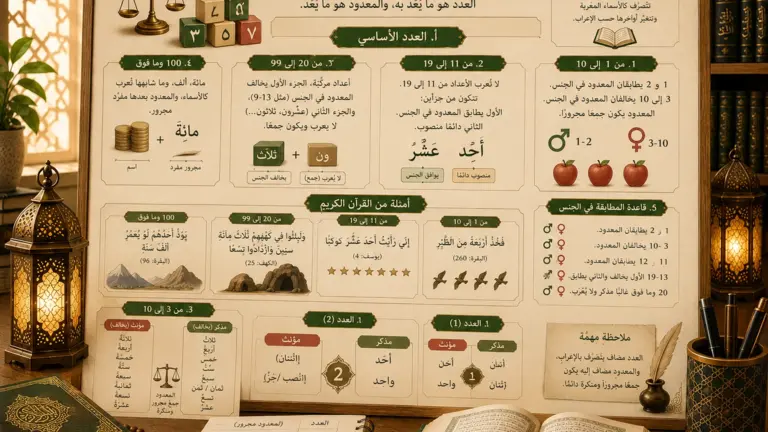
Arabic numbers are an essential foundation for learning Arabic. They are used to talk about age, quantities, dates, prices, times, years, distances and many everyday situations.
In Arabic, the number is called العَدَدُ, while the counted noun is called المَعْدُودُ. Studying Arabic numbers is important because the rules change according to gender, number, grammatical case and the type of number used.
In this complete lesson, we will study Arabic numbers progressively: numbers 1 and 2, numbers 3 to 10, numbers 11 to 19, tens from 20 to 90, compound numbers from 21 to 99, hundreds, thousands, ordinal numbers, fractions and several numerical expressions found in the Quran.
The number and the counted noun in Arabic
To understand Arabic numbers, you must first distinguish two elements:
- العَدَدُ: the number;
- المَعْدُودُ: the counted noun.
Example:
ثَلَاثَةُ كُتُبٍ
Three books.
In this expression, ثَلَاثَةُ is the number, while كُتُبٍ is the counted noun.
Arabic numbers do not follow one single rule. Some agree with the noun, some take the opposite gender, some are followed by a singular accusative noun, and others are followed by a genitive noun.
General table of Arabic number rules
| Category | Main rule | Counted noun | Example |
|---|---|---|---|
| 1 and 2 | Agreement with the noun | Singular or dual | كِتَابٌ وَاحِدٌ |
| 3 to 10 | Opposite gender to the counted noun | Plural genitive | ثَلَاثَةُ كُتُبٍ |
| 11 and 12 | Agreement with the counted noun | Singular accusative | أَحَدَ عَشَرَ طَالِبًا |
| 13 to 19 | First part opposite, second part agreeing | Singular accusative | ثَلَاثَةَ عَشَرَ طَالِبًا |
| 20 to 90 | Forms in ـونَ / ـينَ | Singular accusative | عِشْرُونَ طَالِبًا |
| 100 and 1000 | Function like nouns | Singular genitive | مِئَةُ رَجُلٍ |
Numbers 1 and 2 in Arabic
Arabic numbers 1 and 2 follow a special rule. Unlike numbers 3 to 10, they often behave like adjectives. They usually come after the noun and agree with it in gender, number and grammatical case.
For number 1, the noun is usually singular. The number reinforces the idea of oneness.
- كِتَابٌ وَاحِدٌ: one single book;
- كُرَّاسَةٌ وَاحِدَةٌ: one single notebook;
- قَلَمٌ وَاحِدٌ: one single pen;
- بَقَرَةٌ وَاحِدَةٌ: one single cow.
For number 2, the noun is usually dual. The dual form already indicates two, and the number often confirms that quantity.
| Number | Masculine | Feminine | Example |
|---|---|---|---|
| 1 | وَاحِدٌ | وَاحِدَةٌ | كِتَابٌ وَاحِدٌ |
| 2 nominative | اِثْنَانِ | اِثْنَتَانِ | كِتَابَانِ اِثْنَانِ |
| 2 accusative / genitive | اِثْنَيْنِ | اِثْنَتَيْنِ | قِصَّتَيْنِ اِثْنَتَيْنِ |
Examples:
- رَأَيْتُ جُنْدِيًّا وَاحِدًا: I saw one soldier;
- قَرَأَتْ قِصَّةً وَاحِدَةً: she read one story;
- هَذَانِ أَخَوَانِ اِثْنَانِ: these are two brothers;
- دَرَسَتْ قِصَّتَيْنِ اِثْنَتَيْنِ: she studied two stories.
Numbers 3 to 10 in Arabic
Arabic numbers 3 to 10 follow a different rule. The number usually comes before the counted noun, and the counted noun is plural, indefinite and genitive.
The main rule is gender opposition:
- if the counted noun is masculine, the number takes a feminine form;
- if the counted noun is feminine, the number takes a masculine form.
Examples:
- ثَلَاثَةُ كُتُبٍ: three books;
- ثَلَاثُ أَخَوَاتٍ: three sisters;
- خَمْسَةُ رِجَالٍ: five men;
- خَمْسُ نِسَاءٍ: five women.
Table of numbers 3 to 10 with masculine and feminine nouns
| Number | With masculine noun | With feminine noun |
|---|---|---|
| 3 | ثَلَاثَةُ كُتُبٍ | ثَلَاثُ أَخَوَاتٍ |
| 4 | أَرْبَعَةُ رِجَالٍ | أَرْبَعُ كَلِمَاتٍ |
| 5 | خَمْسَةُ أَوْلَادٍ | خَمْسُ نِسَاءٍ |
| 6 | سِتَّةُ أَيَّامٍ | سِتُّ صَدِيقَاتٍ |
| 7 | سَبْعَةُ أَبْوَابٍ | سَبْعُ جَامِعَاتٍ |
| 8 | ثَمَانِيَةُ قِصَصٍ | ثَمَانِيَ مُدُنٍ |
| 9 | تِسْعَةُ إِخْوَةٍ | تِسْعُ طَبِيبَاتٍ |
| 10 | عَشَرَةُ أَشْخَاصٍ | عَشْرُ عَمَّاتٍ |
Important rules for numbers 3 to 10
- The number comes before the counted noun.
- The counted noun is generally plural.
- The counted noun is genitive.
- The counted noun is generally indefinite.
- The number often takes the opposite gender to the counted noun.
Examples:
- فِي البَيْتِ ثَلَاثَةُ أَوْلَادٍ: there are three children in the house;
- فِي حَقِيبَتِي خَمْسَةُ أَقْلَامٍ: there are five pens in my bag;
- عِنْدِي ثَلَاثُ كُرَّاسَاتٍ: I have three notebooks;
- زَارَتْ حَمِيدَةُ ثَمَانِيَ مُدُنٍ: Hamida visited eight cities.
Numbers 11 to 19 in Arabic
Arabic numbers 11 to 19 are compound numbers. They are formed with a first part related to the unit and a second part related to the word “ten”.
Numbers 11 and 12 have special rules. Numbers 13 to 19 follow another rule, related to the opposition between the gender of the first part of the number and the gender of the counted noun.
Table of Arabic numbers 11 to 19
| Number | With masculine noun | With feminine noun |
|---|---|---|
| 11 | أَحَدَ عَشَرَ | إِحْدَى عَشْرَةَ |
| 12 | اِثْنَا عَشَرَ | اِثْنَتَا عَشْرَةَ |
| 13 | ثَلَاثَةَ عَشَرَ | ثَلَاثَ عَشْرَةَ |
| 14 | أَرْبَعَةَ عَشَرَ | أَرْبَعَ عَشْرَةَ |
| 15 | خَمْسَةَ عَشَرَ | خَمْسَ عَشْرَةَ |
| 16 | سِتَّةَ عَشَرَ | سِتَّ عَشْرَةَ |
| 17 | سَبْعَةَ عَشَرَ | سَبْعَ عَشْرَةَ |
| 18 | ثَمَانِيَةَ عَشَرَ | ثَمَانِيَ عَشْرَةَ |
| 19 | تِسْعَةَ عَشَرَ | تِسْعَ عَشْرَةَ |
Rules for 11 and 12
Numbers 11 and 12 generally agree with the gender of the counted noun.
- أَحَدَ عَشَرَ أُسْتَاذًا: eleven male teachers;
- إِحْدَى عَشْرَةَ أُسْتَاذَةً: eleven female teachers;
- اِثْنَا عَشَرَ مُهَنْدِسًا: twelve male engineers;
- اِثْنَتَا عَشْرَةَ مُهَنْدِسَةً: twelve female engineers.
Number 12 also has special forms according to grammatical case:
- masculine nominative: اِثْنَا عَشَرَ;
- masculine accusative / genitive: اِثْنَيْ عَشَرَ;
- feminine nominative: اِثْنَتَا عَشْرَةَ;
- feminine accusative / genitive: اِثْنَتَيْ عَشْرَةَ.
Rule for numbers 13 to 19
For Arabic numbers 13 to 19, the rule has two parts:
- the first part of the number takes the opposite gender to the counted noun;
- the second part agrees with the counted noun.
Examples:
- ثَلَاثَةَ عَشَرَ طَالِبًا: thirteen male students;
- ثَلَاثَ عَشْرَةَ مُدَرِّسَةً: thirteen female teachers;
- أَرْبَعَةَ عَشَرَ كِتَابًا: fourteen books;
- خَمْسَ عَشْرَةَ سَاعَةً: fifteen hours.
The noun following numbers 11 to 19 is generally singular and accusative. It functions as a specification, called تَمْيِيزٌ.
The tens in Arabic from 20 to 90
The tens in Arabic are called أَلْفَاظُ العُقُودِ. They correspond to the numbers 20, 30, 40, 50, 60, 70, 80 and 90.
These numbers behave like the sound masculine plural, called جَمْعُ المُذَكَّرِ السَّالِمُ. They take:
- ـونَ in the nominative;
- ـينَ in the accusative and genitive.
Table of Arabic tens
| Number | Arabic digits | Nominative | Accusative / Genitive |
|---|---|---|---|
| 20 | ٢٠ | عِشْرُونَ | عِشْرِينَ |
| 30 | ٣٠ | ثَلَاثُونَ | ثَلَاثِينَ |
| 40 | ٤٠ | أَرْبَعُونَ | أَرْبَعِينَ |
| 50 | ٥٠ | خَمْسُونَ | خَمْسِينَ |
| 60 | ٦٠ | سِتُّونَ | سِتِّينَ |
| 70 | ٧٠ | سَبْعُونَ | سَبْعِينَ |
| 80 | ٨٠ | ثَمَانُونَ | ثَمَانِينَ |
| 90 | ٩٠ | تِسْعُونَ | تِسْعِينَ |
Nominative, accusative and genitive forms of the tens
Because the tens follow the sound masculine plural pattern, their ending changes according to their grammatical function in the sentence.
| Case | Arabic example | Translation | Form |
|---|---|---|---|
| Nominative | جَاءَ عِشْرُونَ طَالِبًا | Twenty students came. | عِشْرُونَ |
| Accusative | رَأَيْتُ عِشْرِينَ طَالِبًا | I saw twenty students. | عِشْرِينَ |
| Genitive | تَحَدَّثْتُ مَعَ عِشْرِينَ طَالِبًا | I spoke with twenty students. | عِشْرِينَ |
The noun following the tens is generally singular and accusative:
- عِشْرُونَ طَالِبًا: twenty students;
- ثَلَاثُونَ كِتَابًا: thirty books;
- أَرْبَعُونَ قِصَّةً: forty stories;
- خَمْسُونَ أُسْتَاذًا: fifty teachers.
Compound numbers from 21 to 99
Compound numbers from 21 to 99 are formed by placing the conjunction وَ between the unit and the ten.
Examples:
- وَاحِدٌ وَعِشْرُونَ: twenty-one, with a masculine noun;
- إِحْدَى وَعِشْرُونَ: twenty-one, with a feminine noun;
- اِثْنَانِ وَعِشْرُونَ: twenty-two, nominative masculine;
- اِثْنَتَانِ وَعِشْرُونَ: twenty-two, nominative feminine;
- تِسْعٌ وَتِسْعُونَ: ninety-nine.
In compound numbers, the unit follows its own rules, while the ten follows the declension pattern in ـونَ or ـينَ.
Arabic hundreds from 100 to 900
In Arabic, hundreds are built around the word مِئَة, meaning “hundred”. In modern usage, the spelling مائة is also found. Both forms are understood.
| Number | Arabic | Transliteration |
|---|---|---|
| 100 | مِئَة | miʾah |
| 200 | مِئَتَانِ | miʾatān |
| 300 | ثَلَاثُمِئَة | thalāthumiʾah |
| 400 | أَرْبَعُمِئَة | arbaʿumiʾah |
| 500 | خَمْسُمِئَة | khamsumiʾah |
| 600 | سِتُّمِئَة | sittumiʾah |
| 700 | سَبْعُمِئَة | sabʿumiʾah |
| 800 | ثَمَانِمِئَة | thamānimiʾah |
| 900 | تِسْعُمِئَة | tisʿumiʾah |
The noun following hundreds is generally singular and genitive:
- مِئَةُ رَجُلٍ: one hundred men;
- ثَلَاثُمِئَةُ رَجُلٍ: three hundred men;
- أَرْبَعُمِئَةِ عَامٍ: four hundred years.
Declension of hundreds
| Case | Arabic example | Translation |
|---|---|---|
| Nominative | جَاءَتْ مِئَةُ رَجُلٍ | One hundred men came. |
| Accusative | رَأَيْتُ مِئَةَ رَجُلٍ | I saw one hundred men. |
| Genitive | ذَهَبْتُ مَعَ مِئَةِ رَجُلٍ | I went with one hundred men. |
Arabic thousands from 1000 to 9000
The Arabic word for “thousand” is أَلْف. To express two thousand, Arabic uses the dual. From three thousand onward, the number is followed by the plural آلَاف.
| Number | Arabic | Transliteration |
|---|---|---|
| 1000 | أَلْف | alf |
| 2000 | أَلْفَانِ | alfān |
| 3000 | ثَلَاثَةُ آلَافٍ | thalāthatu ālāf |
| 4000 | أَرْبَعَةُ آلَافٍ | arbaʿatu ālāf |
| 5000 | خَمْسَةُ آلَافٍ | khamsatu ālāf |
| 6000 | سِتَّةُ آلَافٍ | sittatu ālāf |
| 7000 | سَبْعَةُ آلَافٍ | sabʿatu ālāf |
| 8000 | ثَمَانِيَةُ آلَافٍ | thamāniyatu ālāf |
| 9000 | تِسْعَةُ آلَافٍ | tisʿatu ālāf |
The noun following thousands is generally singular and genitive:
- أَلْفُ رَجُلٍ: one thousand men;
- ثَلَاثَةُ آلَافِ رَجُلٍ: three thousand men;
- مِئَةُ أَلْفٍ: one hundred thousand.
Declension of thousands
| Case | Arabic example | Translation |
|---|---|---|
| Nominative | جَاءَ أَلْفُ رَجُلٍ | One thousand men came. |
| Accusative | رَأَيْتُ أَلْفَ رَجُلٍ | I saw one thousand men. |
| Genitive | ذَهَبْتُ مَعَ أَلْفِ رَجُلٍ | I went with one thousand men. |
Quranic examples with cardinal numbers
Numbers often appear in the Quran. Recognizing them helps students understand the rules of العَدَدُ and المَعْدُودُ.
إِنِّي رَأَيْتُ أَحَدَ عَشَرَ كَوْكَبًا
I saw eleven stars. (12:4)
إِنَّ عِدَّةَ الشُّهُورِ عِندَ اللَّـهِ اثْنَا عَشَرَ شَهْرًا
The number of months with Allah is twelve months. (9:36)
إِن يَكُن مِّنكُمْ عِشْرُونَ صَابِرُونَ
If there are among you twenty steadfast ones. (8:65)
وَحَمْلُهُ وَفِصَالُهُ ثَلَاثُونَ شَهْرًا
His bearing and weaning are thirty months. (46:15)
فَاجْلِدُوهُمْ ثَمَانِينَ جَلْدَةً
Flog them with eighty lashes. (24:4)
وَأَرْسَلْنَاهُ إِلَىٰ مِائَةِ أَلْفٍ أَوْ يَزِيدُونَ
And We sent him to one hundred thousand or more. (37:147)
Ordinal numbers in Arabic
Ordinal numbers indicate rank: first, second, third, fourth, and so on. In Arabic, they generally follow the pattern of the active participle فَاعِلٌ.
| Rank | Masculine | Feminine |
|---|---|---|
| First | الأَوَّلُ | الأُولَى |
| Second | الثَّانِي | الثَّانِيَةُ |
| Third | الثَّالِثُ | الثَّالِثَةُ |
| Fourth | الرَّابِعُ | الرَّابِعَةُ |
| Fifth | الخَامِسُ | الخَامِسَةُ |
| Sixth | السَّادِسُ | السَّادِسَةُ |
| Seventh | السَّابِعُ | السَّابِعَةُ |
| Eighth | الثَّامِنُ | الثَّامِنَةُ |
| Ninth | التَّاسِعُ | التَّاسِعَةُ |
| Tenth | العَاشِرُ | العَاشِرَةُ |
Quranic examples:
هُوَ الْأَوَّلُ وَالْآخِرُ
He is the First and the Last. (57:3)
ثَانِيَ اثْنَيْنِ إِذْ هُمَا فِي الْغَارِ
The second of the two, when they were in the cave. (9:40)
وَالْخَامِسَةُ أَنَّ لَعْنَتَ اللَّـهِ عَلَيْهِ
And the fifth time, that Allah’s curse be upon him. (24:7)
Fractions in Arabic
Numerical fractions, except for half, often follow the pattern فُعُلٌ in Arabic.
| Fraction | Arabic |
|---|---|
| Half | نِصْفٌ |
| One third | ثُلُثٌ |
| One quarter | رُبُعٌ |
| One fifth | خُمُسٌ |
| One sixth | سُدُسٌ |
| One seventh | سُبُعٌ |
| One eighth | ثُمُنٌ |
| One ninth | تُسُعٌ |
| One tenth | عُشُرٌ |
| Two thirds | ثُلُثَانِ / ثُلُثَيْنِ |
Quranic examples:
وَلَكُمْ نِصْفُ مَا تَرَكَ أَزْوَاجُكُمْ
And for you is half of what your wives leave. (4:12)
فَلَكُمُ الرُّبُعُ مِمَّا تَرَكْنَ
Then for you is one quarter of what they leave. (4:12)
وَلِأَبَوَيْهِ لِكُلِّ وَاحِدٍ مِّنْهُمَا السُّدُسُ
And for his two parents, for each one of them, is one sixth. (4:11)
Distributive adjectives in Arabic
Some adjectives have a numerical value in Arabic. They express distribution: two by two, three by three, four by four.
- مَثْنَى: two by two;
- ثُلَاثَ: three by three;
- رُبَاعَ: four by four.
فَانكِحُوا مَا طَابَ لَكُم مِّنَ النِّسَاءِ مَثْنَىٰ وَثُلَاثَ وَرُبَاعَ
Marry those who please you among women, two, three or four. (4:3)
Expressions of repetition
Arabic also has expressions for “once”, “twice”, “three times” and “each time”.
- مَرَّةً: once;
- مَرَّتَانِ / مَرَّتَيْنِ: twice;
- ثَلَاثَ مَرَّاتٍ: three times;
- كُلُّ مَرَّةٍ: every time;
- أَوَّلُ مَرَّةٍ: the first time;
- مَرَّةً أُخْرَى / تَارَةً أُخْرَى: another time.
كَمَا خَلَقْنَاكُمْ أَوَّلَ مَرَّةٍ
As We created you the first time. (18:48)
أَوَلَا يَرَوْنَ أَنَّهُمْ يُفْتَنُونَ فِي كُلِّ عَامٍ مَّرَّةً أَوْ مَرَّتَيْنِ
Do they not see that they are tested every year once or twice? (9:126)
Expressing “both”, “all” and “together”
To emphasize duality, Arabic uses كِلَا for the masculine and كِلْتَا for the feminine. To express totality, Arabic often uses كُلٌّ or جَمِيعٌ.
- كِلَا: both, masculine;
- كِلْتَا: both, feminine;
- كُلٌّ: all, every;
- جَمِيعٌ: all, together.
كِلْتَا الْجَنَّتَيْنِ آتَتْ أُكُلَهَا
Each of the two gardens gave its produce. (18:33)
فَسَجَدَ الْمَلَائِكَةُ كُلُّهُمْ أَجْمَعُونَ
So the angels all prostrated together. (15:30)
وَاعْتَصِمُوا بِحَبْلِ اللَّـهِ جَمِيعًا وَلَا تَفَرَّقُوا
Hold firmly to the rope of Allah all together and do not divide. (3:103)
The word آخَر: another, last or following
The word آخَر can mean “another”, “following” or “last” depending on context.
| Form | Arabic |
|---|---|
| Masculine singular | آخَرُ |
| Feminine singular | أُخْرَى |
| Masculine plural | آخَرُونَ / آخَرِينَ |
| Feminine plural | أُخَرٌ |
وَقَالَ الْآخَرُ إِنِّي أَرَانِي أَحْمِلُ فَوْقَ رَأْسِي خُبْزًا
The other said: “I saw myself carrying bread on my head.” (12:36)
وَمِنَ النَّاسِ مَن يَقُولُ آمَنَّا بِاللَّـهِ وَبِالْيَوْمِ الْآخِرِ
Among the people are those who say: “We believe in Allah and the Last Day.” (2:8)
The expressions كَمْ, كَأَيِّنْ and بِضْع
When كَمْ or كَأَيِّنْ are followed by مِنْ, they express the meaning of “how many” or “many”.
سَلْ بَنِي إِسْرَائِيلَ كَمْ آتَيْنَاهُم مِّنْ آيَةٍ بَيِّنَةٍ
Ask the Children of Israel how many clear signs We gave them. (2:211)
وَكَأَيِّن مِّن نَّبِيٍّ قَاتَلَ
And how many prophets fought. (3:146)
The word بِضْعٌ or بِضْعَةٌ means “a few” or “a certain number”. It generally refers to a number between three and nine.
فِي بِضْعِ سِنِينَ
Within a few years. (30:4)
Common mistakes with Arabic numbers
- Confusing the rule of 1 and 2 with the rule of numbers 3 to 10.
- Forgetting that numbers 3 to 10 often take the opposite gender to the counted noun.
- Putting the counted noun in the singular after numbers 3 to 10.
- Forgetting that the counted noun after 3 to 10 is generally plural and genitive.
- Forgetting that the counted noun after 11 to 99 is generally singular and accusative.
- Confusing عِشْرُونَ and عِشْرِينَ.
- Forgetting that the counted noun after hundreds and thousands is generally singular and genitive.
- Translating numbers word for word from English.
How to memorize Arabic numbers
To memorize Arabic numbers, it is better to learn the rules by groups. Each group has its own logic.
- Start with numbers 1 and 2 with masculine and feminine nouns.
- Then study numbers 3 to 10 with the gender opposition rule.
- Learn numbers 11 to 19 with the counted noun in the singular accusative.
- Memorize the tens from 20 to 90 with the forms ـونَ and ـينَ.
- Study compound numbers from 21 to 99 with the conjunction وَ.
- Learn hundreds and thousands as nominal constructions.
- Practice with complete sentences rather than isolated lists.
Why learn Arabic numbers?
Numbers are indispensable for learning Arabic. They appear in everyday conversations, texts, times, prices, dates, exercises, administrative documents, stories and religious texts.
Mastering Arabic numbers helps you:
- strengthen Arabic vocabulary;
- improve Arabic reading;
- understand masculine and feminine rules;
- progress in Arabic grammar;
- use Arabic digits in simple sentences;
- understand Modern Standard Arabic texts;
- prepare for more advanced texts.
Learn Arabic numbers with a teacher
Arabic numbers require practice because their form changes according to the gender of the counted noun, grammatical case and the type of number used. An Arabic teacher can help you understand these rules, correct your pronunciation and teach you how to use numbers in complete sentences.
At Al-Dirassa, you can follow online Arabic courses with personalized support. These courses are adapted to adults, children, beginners and students who want to progress in literary Arabic, Modern Standard Arabic or Quranic Arabic.
To strengthen your foundations, you can review the Arabic alphabet, use free Arabic learning resources or discover our Arabic courses for children, adapted to each child’s age and level.
Book your free trial of 30 minutes
Registration form
FAQ — Arabic numbers
How do you say “number” in Arabic?
You say عَدَدٌ. The counted noun is called مَعْدُودٌ.
What is the rule for numbers 1 and 2 in Arabic?
Numbers 1 and 2 often behave like adjectives. They follow the noun and agree with it in gender, number and grammatical case.
What is the rule for numbers 3 to 10 in Arabic?
Numbers 3 to 10 generally take the opposite gender to the counted noun. The counted noun is usually plural and genitive.
What is the rule for numbers 11 to 19?
The counted noun after numbers 11 to 19 is generally singular and accusative. Numbers 11 and 12 agree with the noun, while 13 to 19 follow a compound rule.
How do the tens work in Arabic?
The tens from 20 to 90 end in ـونَ in the nominative and ـينَ in the accusative and genitive.
What case does the noun take after the tens?
After the tens, the counted noun is generally singular and accusative.
What case does the noun take after hundreds and thousands?
After hundreds and thousands, the counted noun is generally singular and genitive.
What is the difference between cardinal and ordinal numbers?
A cardinal number indicates quantity, such as three or twenty. An ordinal number indicates rank, such as third or twentieth.
Conclusion
Arabic numbers are an important part of Arabic grammar. They are not only vocabulary lists: they also involve gender, singular, dual, plural, accusative, genitive and agreement with the counted noun.
The main rules to remember are the following: numbers 1 and 2 agree with the noun; numbers 3 to 10 often take the opposite gender; numbers 11 to 99 are generally followed by a singular accusative noun; hundreds and thousands are generally followed by a singular genitive noun.
With a progressive method, regular examples and correction from a teacher, Arabic numbers become clearer and easier to use in sentences, reading and text comprehension.






No Comments
No comments yet.
No comments yet.