
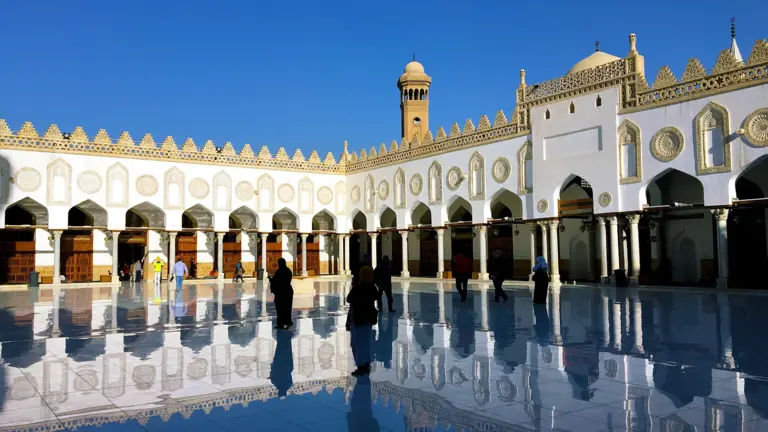
Al-Azhar Mosque, located in the heart of Cairo, is one of the most important landmarks in Islamic history. It is known not only as a mosque, but also as a historic center of Islamic learning and scholarship.
For more than a thousand years, Al-Azhar has been associated with the study of the Quran, Arabic language, Fiqh, Hadith, Islamic belief and the wider Islamic sciences. Its history shows the central place of knowledge in Muslim civilization.
In this article, we will explore the history of Al-Azhar Mosque, its role in Islamic education, its architecture and what its legacy teaches us about the importance of structured Islamic learning.
Why Al-Azhar Mosque Matters in Islamic History
Al-Azhar is not only a famous mosque in Cairo. Over the centuries, it became a symbol of Islamic knowledge. Generations of students studied Arabic, Quran, Fiqh, Islamic belief and other religious sciences within its walls.
In the Muslim tradition, the mosque is not only a place of prayer. It can also be a place of teaching, reading, memorization, guidance and transmission. Al-Azhar strongly reflects this connection between worship and knowledge.
Its history reminds us that learning Islam requires time, teachers, reliable texts and regular progress. This lesson remains important for anyone who wants to learn Islam today, whether in an institute, in a mosque or through online Islamic classes.
The Foundation of Al-Azhar in Cairo
Al-Azhar Mosque was founded in Cairo during the Fatimid period. Its construction began in the 10th century, shortly after the establishment of the city of Cairo. It quickly became one of the major monuments of the Egyptian capital.
The name Al-Azhar is commonly associated with Fatimah Az-Zahra, the daughter of the Prophet. Although the exact origin of the name has been discussed by historians, this association explains part of the symbolic value attached to the mosque in Muslim memory.
Over time, Al-Azhar did not remain only a place of prayer. It gradually became a space for study and transmission, attracting students from Egypt and from many other parts of the Muslim world.
From Mosque to Center of Islamic Learning
One of the distinctive features of Al-Azhar is its role in education. In many Muslim societies, mosques served as centers of learning. Students gathered around scholars to study texts, ask questions and receive religious instruction.
Al-Azhar belongs to this tradition. It became a center where the main Islamic sciences were studied, along with the Arabic language, which is essential for understanding religious texts.
Quran and recitation
The Quran occupies a central place in Islamic learning. Studying the Quran includes reading, memorization, recitation, Tajweed and understanding the general meaning of the verses.
Throughout history, institutions of knowledge such as Al-Azhar helped preserve Quran recitation and transmit the rules needed for correct reading. This shows the importance of learning the Quran with method and, when possible, with a qualified teacher.
Fiqh and religious sciences
Fiqh refers to the understanding of the practical rulings of Islam. It includes the study of purification, prayer, fasting, zakat, pilgrimage and other subjects related to religious practice.
In a learning path, Fiqh helps students understand how to apply the basic rules of Islam in daily life. It should be studied gradually, with explanations adapted to the student’s level.
Arabic language and the transmission of knowledge
The Arabic language has an essential place in Islamic sciences. It gives access to the Quran, Hadith, supplications, books of Fiqh and explanations written by scholars.
Understanding Quranic Arabic helps students better grasp religious terms, Quranic expressions and the vocabulary used in Islamic lessons. This is why learning Arabic and learning Islam are often closely connected.
The Architecture of Al-Azhar Mosque
Al-Azhar Mosque is also an important architectural monument. It has undergone several expansions and restorations throughout its history. Its courtyards, galleries, mihrabs, minarets and study spaces reflect different periods of Cairo’s history.
Like many great Islamic monuments, Al-Azhar was expanded and beautified by different rulers, emirs and patrons. Each period left its mark on the building.
This evolution shows that places of knowledge are not static. They develop over time according to the needs of students, teachers and the wider community.
Restorations and Major Expansions
Over the centuries, Al-Azhar Mosque has gone through many restorations. Some focused on its gates, galleries, minarets, floors, prayer spaces and decorative elements.
Madrasas and learning spaces were also added around the mosque. These additions show that religious education was at the heart of Al-Azhar’s role.
The successive restorations helped preserve the building while also allowing it to continue its living function: welcoming worshippers, teachers and students.
Al-Azhar and the Transmission of Knowledge Today
Al-Azhar remains associated with the transmission of Islamic knowledge. It reminds us that religious learning is not based only on individual reading, but also on teaching, method, regularity and guidance.
Studying Islam requires understanding the foundations before moving to advanced topics. Islamic belief, purification, prayer, Quran, Hadith, Sunnah and Fiqh should be learned in a clear order.
This gradual approach is useful for adults, beginners, children and anyone who wants to learn Islam seriously.
What Al-Azhar Teaches Us About Learning Islam
The history of Al-Azhar shows that Islamic knowledge is learned with patience. Great institutions were not built in one day, and students do not progress without regular effort.
To learn Islam, it is important to follow a clear path: understand the basics of faith, learn purification and prayer, study the Quran, discover essential Hadith, then move gradually toward more detailed Islamic sciences.
If you want to follow a structured path, you can explore our Islamic sciences online program. It helps students study the foundations of Islam, Islamic belief, Fiqh, prayer and essential religious concepts with suitable guidance.
You can also read our guide to learn Islam online, explore our Islamic culture resources, or continue with our Quranic Arabic course and online Quran and Tajweed classes.
Book your free trial of 30 minutes
Registration form
Conclusion
Al-Azhar Mosque is one of the great symbols of Islamic learning. Its history brings together prayer, teaching, Arabic language, Quran, Fiqh and the transmission of religious sciences.
It reminds us that learning Islam requires method, regularity, reliable sources and guidance from qualified teachers. An article can provide an introduction, but complete learning requires a structured and progressive path.
By studying the history of Al-Azhar, readers can better understand the importance of knowledge in the Muslim tradition and the need to learn Islam with seriousness, balance and patience.





No Comments
No comments yet.
No comments yet.