
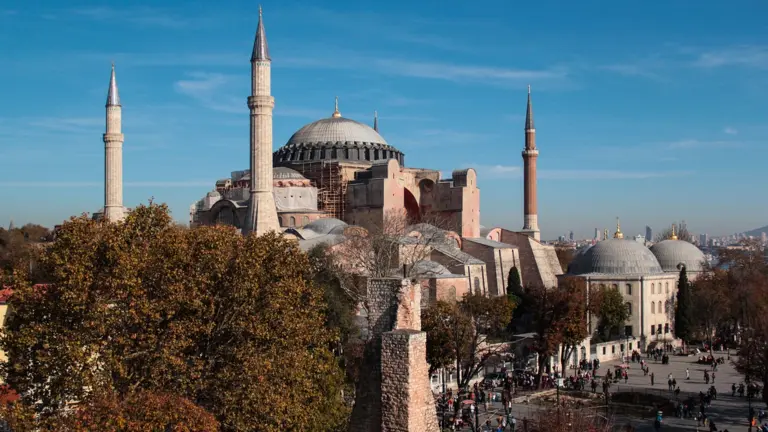
Hagia Sophia Mosque, located in the heart of Istanbul, is one of the most famous monuments in the world. Known in Turkish as Aya Sofya, it has passed through more than fifteen centuries of religious, imperial and architectural history.
Its story is connected to the Byzantine Empire, the Ottoman conquest of Constantinople, the history of modern Turkey and its current status as a mosque. Hagia Sophia is therefore a complex monument: historical, spiritual, architectural and symbolic.
In this article, we will explore the history of Hagia Sophia Mosque in Istanbul, its architecture, its transformations and what it can teach us about Islamic history, Muslim culture and the place of the mosque in religious life.
Why Is Hagia Sophia Such an Important Monument?
Hagia Sophia holds a special place in the history of Istanbul. Its immense dome, vast interior and central location made it one of the great imperial monuments of the city for centuries.
It is also important because it has had several functions over time. It was first a major Byzantine cathedral, then an Ottoman mosque, later a museum, and then again a mosque. These successive statuses reflect the complex history of Istanbul, a city shaped by Byzantine, Ottoman and Muslim heritage.
For readers who want to better understand Islam and its history, Hagia Sophia offers a way to observe how places, civilizations and political powers have shaped religious space over time.
From Byzantine Origins to the Ottoman Period
The history of Hagia Sophia began long before the Ottoman period. The current building was constructed in the 6th century under Emperor Justinian, when Constantinople was the capital of the Byzantine Empire.
Construction under Emperor Justinian
The construction of the present monument took place between 532 and 537. Hagia Sophia then became one of the largest religious buildings in the world. Its architecture impressed visitors with its monumental dome and the scale of its interior space.
The building represents an important step in architectural history. It shows how builders of that time sought to create a space that was majestic, symbolic and suited to worship.
The conquest of Constantinople and its conversion into a mosque
In 1453, Constantinople was conquered by the Ottomans under Sultan Mehmed II. After the conquest, Hagia Sophia was converted into a mosque.
Islamic elements were gradually added to the building, including minarets, a mihrab, a minbar and large calligraphic panels. These additions gave the monument a new religious function while preserving much of its older architecture.
This transformation illustrates a recurring reality in the history of great cities: monuments can change function according to different periods, authorities and communities.
The museum period and its return as a mosque
In the 20th century, Hagia Sophia became a museum. During this period, its heritage value was emphasized, and visitors from around the world came to admire its architecture, mosaics, domes and historical layers.
In 2020, Hagia Sophia returned to the status of a mosque. It once again became an active place of prayer while remaining one of Istanbul’s major historical monuments.
Architecture Between Byzantine Heritage and Ottoman Additions
The architecture of Hagia Sophia is unique because it brings together several layers of history. Its great dome, arches, galleries and interior volumes reflect its Byzantine origin.
The minarets, mihrab, minbar and large calligraphic panels reflect its Ottoman history and its use as a mosque. This combination gives the building a distinct visual identity.
To understand Hagia Sophia, one must observe both its Byzantine heritage and the transformations introduced during the Ottoman Muslim period. This helps readers better understand the richness of Istanbul’s history.
Hagia Sophia as a Place of Prayer and Spirituality
Today, Hagia Sophia is a mosque where Muslims gather for prayer. Like every mosque, it is a place of worship, reflection, Quran recitation and remembrance of Allah.
For visitors, it is important to keep this spiritual function in mind. Hagia Sophia is not only an architectural monument; it is also a living religious place.
The mosque occupies a central place in Muslim life. It gathers believers, reminds them of the importance of prayer and strengthens the sense of community.
What Hagia Sophia Teaches About Istanbul’s Islamic History
Hagia Sophia helps us better understand the Islamic history of Istanbul. After the Ottoman conquest, the city became a major center of the Muslim world, with its mosques, schools, libraries, markets and religious institutions.
The history of Hagia Sophia also shows that Islamic civilization often interacted with diverse architectural legacies. The Ottomans added elements specific to the mosque while preserving an important part of the existing building.
This monument therefore reminds us of the historical depth of Istanbul and the role of architecture in the religious and cultural memory of peoples.
Understanding Islam Through Its Heritage
Studying a monument such as Hagia Sophia can become an entry point to a better understanding of Islam, its history and its civilization. Mosques, schools, libraries and centers of knowledge have always played an important role in religious transmission.
However, discovering a monument is not enough to learn Islam in depth. Islamic learning requires a clear progression: understanding the foundations of faith, prayer, purification, Quran, Sunnah, Hadith and the essential rules of religious practice.
To go further, you can explore our Islamic articles and culture resources or follow a structured path to learn Islam.
If you want to study Islamic belief, prayer, Fiqh, Quran and religious sciences with method, our Islamic sciences online program can guide you step by step. You can also discover our online Quran and Tajweed classes.
Book your free trial of 30 minutes
Registration form
Conclusion
Hagia Sophia Mosque in Istanbul is an imperial, religious and historical monument of exceptional importance. Its journey from Byzantine cathedral to Ottoman mosque, then from museum to active mosque again, reflects the richness and complexity of Istanbul’s history.
Its architecture brings together several legacies and reminds us that monuments can cross centuries while changing function and preserving strong symbolic value.
For Muslim readers, and for anyone interested in Islamic history, Hagia Sophia also reminds us that the mosque is a place of prayer, community and transmission. An article can open the door to reflection, but complete Islamic learning requires method, regularity, reliable sources and guidance from a qualified teacher.




No Comments
No comments yet.
No comments yet.