
1. Introduction
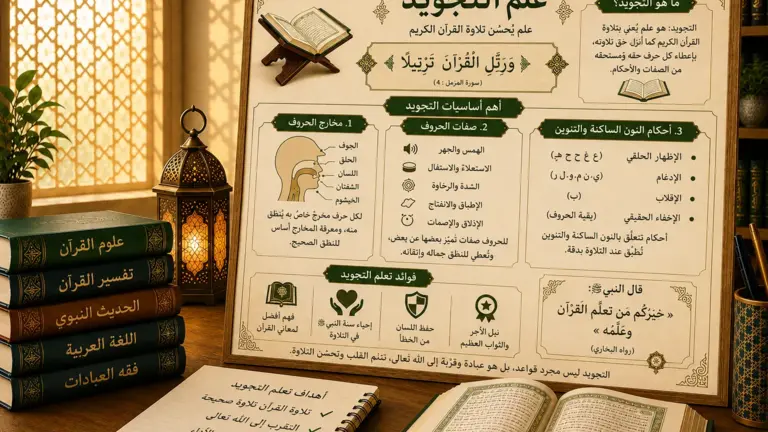
This lesson is designed to help you review the Arabic alphabet and strengthen the foundations required for reading the Holy Quran correctly. The Arabic alphabet consists of 28 letters, each of which may appear in different forms depending on its position within a word.
To recite the Quran correctly, it is essential to recognize each letter, understand its pronunciation, and learn the vowels and pronunciation rules associated with it.
An Arabic letter may appear in different forms depending on whether it is isolated, at the beginning, in the middle, or at the end of a word.
2. Using the Arabic Alphabet in Quranic Words
Correct Quranic recitation requires giving every letter its due right. This involves three essential elements:
- Applying the Arabic vowels (حَرَكَاتٌ) correctly.
- Pronouncing each letter according to its proper articulation point (مَخْرَجٌ).
- Respecting the intrinsic characteristics of every letter (صِفَات).
A. Arabic Letters with Similar Sounds in English
Several Arabic letters have sounds that are relatively close to English sounds:
- ب (Ba) → B
- ت (Ta) → T
- ج (Jeem) → J
- د (Dal) → D
- ز (Zay) → Z
- س (Seen) → S
- ش (Sheen) → Sh
- ف (Fa) → F
- ك (Kaf) → K
- ل (Lam) → L
- م (Meem) → M
- ن (Noon) → N
- ه (Ha) → H
- و (Waw) → W
- ي (Ya) → Y
B. Arabic Letters Without Exact English Equivalents
Some Arabic letters have no exact equivalent in English and require special attention during pronunciation:
- ث (Tha)
- خ (Kha)
- ذ (Dhal)
- ر (Ra)
- ص (Sad)
- ض (Dad)
- ط (Ta emphatic)
- ظ (Dha)
- ع ('Ayn)
- غ (Ghayn)
- ق (Qaf)
These letters are among the most distinctive sounds of the Arabic language and are essential for proper Quranic recitation.
3. Arabic Vowels – الحَرَكَات
Arabic vowels are symbols placed above or below letters to indicate pronunciation. They are divided into short vowels and long vowels.
A. Short Vowels
The three short vowels are:
- Fathah (ـَ) – produces the short sound "a"
- Kasrah (ـِ) – produces the short sound "i"
- Dammah (ـُ) – produces the short sound "u"
Examples:
- دَ = Da
- دِ = Di
- دُ = Du
B. Long Vowels – حُرُوفُ الْمَدِّ
Long vowels extend the sound and are represented by three letters:
- ا (Alif) – long "aa"
- و (Waw) – long "oo"
- ي (Ya) – long "ee"
Examples:
- بَا = Baa
- بُو = Booo
- بِي = Bee
C. Absence of a Vowel: Sukoon and Shaddah
Sukoon – ـْ
The Sukoon indicates the absence of a vowel on a letter. The letter is pronounced without any accompanying vowel sound.
Example:
بْ
Shaddah – ـّ
The Shaddah indicates that a letter is doubled. It combines two identical letters, the first carrying a Sukoon and the second carrying a vowel.
Example:
مُّ
Important Note
The following six Arabic letters never connect to the letter that follows them:
ا – د – ذ – ر – ز – و
Recognizing these letters is essential when learning how Arabic words are written and read.
Conclusion
In this lesson, we reviewed the Arabic alphabet, the pronunciation of Arabic letters, the distinction between letters with and without English equivalents, and the essential vowel system used in Quranic recitation.
Mastering the Arabic alphabet is the first step toward reading the Holy Quran correctly. A strong understanding of the letters, vowels, Sukoon, and Shaddah will make future Tajweed lessons much easier to understand and apply.
In the next lesson, we will continue building the foundations of Quran reading by studying the articulation points and pronunciation of Arabic letters in greater detail.
Book your free trial of 30 minutes
Registration form





No Comments
No comments yet.
No comments yet.