
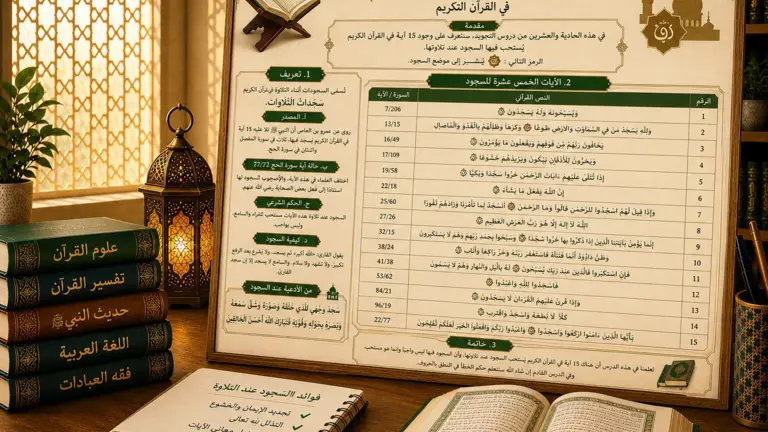
Introduction
In this twenty-first Tajweed lesson on the Holy Quran, we will discover that there are specific verses in the Quran for which it is recommended to perform a prostration during recitation.
The following symbol, ۩, marks the point at which this prostration should be performed.
1. Definition
The prostrations performed during Quran recitation are called سَجْدات التلاوات in Arabic.
A. Source
It is reported from Amr ibn Al-As that the Messenger of Allah (peace and blessings of Allah be upon him) recited to him fifteen verses of the Quran for which prostration is prescribed, three of them in the Mufassal surahs and two in Surah Al-Hajj.
This was reported by Abu Dawud, Ibn Majah, Al-Hakim and Ad-Daraqutni, and was classified as “good” — hasan — by Al-Mundhiri and An-Nawawi.
However, the hadith scholar Al-Albani considered that the chain of transmission of this hadith cannot be classified as good because it contains two unknown narrators.
B. The Case of the Verse in Surah Al-Hajj 22:77
Imam At-Tahawi held the view that there is no second prostration in Surah Al-Hajj at the end of the surah. This was also the opinion of Ibn Hazm, who said in his book Al-Muhalla: “There is no authentic — sahih — proof that this was part of the tradition of the Messenger of Allah (peace and blessings of Allah be upon him), and there is no consensus among the legal schools regarding it.”
However, it has been authentically reported that Umar ibn Al-Khattab, the daughter of Abdullah, and Abu Darda used to perform this prostration at verse 22:77.
Thus, although the chain of transmission of the previously mentioned hadith is weak, many scholars of the Muslim community did not support this prostration at verse 22:77 because there is no proof from the Prophetic tradition or scholarly consensus.
Nevertheless, it has been authentically reported that some Companions used to prostrate after reciting verse 22:77. This may therefore be taken as evidence, especially since nothing has been reported indicating that the Companions disputed this matter. Allah knows best — الله أعلم.
C. The Islamic Ruling on These Prostrations
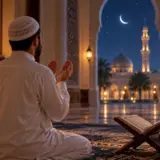
Prostration during the recitation of these verses is recommended for both the reader and the listener, but it is not obligatory.
D. How to Perform the Prostration
If a person wishes to prostrate, it is preferable to say the takbir — الله أَكْبَر — and then prostrate. When rising from the prostration, it is not necessary to say the takbir, the tashahhud or the salam.
However, for the listener, it is not necessary to prostrate if the reciter does not prostrate. Indeed, it has been reported that Zayd ibn Thabit recited Surah An-Najm to the Prophet (peace and blessings of Allah be upon him), and neither he nor the Prophet prostrated.
If the prostration occurs while the reader or listener is in prayer, then the takbir should be said, the prostration performed, and then the person should rise again.
Among the supplications that may be recited during this prostration:
سَجَـدَ وَجْهـي للَّـذي خَلَقَـهُ وَصَـوَّرَهُ وَشَقَّ سَمْـعَـهُ
وَبَصَـرَهُ بِحَـوْلِـهِ وَقُـوَّتِهِ فَتَبَارَكَ اللَّهُ أَحْسَنُ الْخَالِقِين
“My face has prostrated before the One who created it, shaped it, and brought forth its hearing and sight by His power and strength. Blessed is Allah, the best of creators.”
2. The Fifteen Verses of Prostration
| Number | Verse Excerpt | Surah / Verse |
| 1 |
۩ وَيُسَبِّحُونَهُۥ وَلَهُۥ يَسْجُدُونَ |
7:206 |
| 2 |
وَلِلَّـهِ يَسْجُدُ مَن فِى ٱلسَّمَـٰوَٰتِ وَٱلْأَرْضِ طَوْعًا |
13:15 |
| 3 |
۩ يَخَافُونَ رَبَّهُم مِّن فَوْقِهِمْ وَيَفْعَلُونَ مَا يُؤْمَرُونَ |
16:49 |
| 4 |
۩ وَيَخِرُّونَ لِلْأَذْقَانِ يَبْكُونَ وَيَزِيدُهُمْ خُشُوعًا |
17:109 |
| 5 |
۩ إِذَا تُتْلَىٰ عَلَيْهِمْ ءَايَـٰتُ ٱلرَّحْمَـٰنِ خَرُّوا۟ سُجَّدًا وَبُكِيًّا |
19:58 |
| 6 |
۩ إِنَّ ٱللَّـهَ يَفْعَلُ مَا يَشَآءُ |
22:18 |
| 7 |
وَإِذَا قِيلَ لَهُمُ ٱسْجُدُوا۟ لِلرَّحْمَـٰنِ قَالُوا۟ وَمَا ٱلرَّحْمَـٰنُ |
25:60 |
| 8 |
۩ٱللَّـهُ لَآ إِلَـٰهَ إِلَّا هُوَ رَبُّ ٱلْعَرْشِ ٱلْعَظِيمِ |
27:26 |
| 9 |
إِنَّمَا يُؤْمِنُ بِـَٔايَـٰتِنَا ٱلَّذِينَ إِذَا ذُكِّرُوا۟ بِهَا خَرُّوا۟ سُجَّدًا |
32:15 |
| 10 |
۩ وَظَنَّ دَاوُۥدُ أَنَّمَا فَتَنَّـٰهُ فَٱسْتَغْفَرَ رَبَّهُۥ وَخَرَّ رَاكِعًا وَأَنَابَ |
38:24 |
| 11 |
فَإِنِ ٱسْتَكْبَرُوا۟ فَٱلَّذِينَ عِندَ رَبِّكَ يُسَبِّحُونَ |
41:38 |
| 12 |
۩ فَٱسْجُدُوا۟ لِلَّـهِ وَٱعْبُدُوا۟ |
53:62 |
| 13 |
۩ وَإِذَا قُرِئَ عَلَيْهِمُ ٱلْقُرْءَانُ لَا يَسْجُدُونَ |
84:21 |
| 14 |
۩ كَلَّا لَا تُطِعْهُ وَٱسْجُدْ وَٱقْتَرِب |
96:19 |
| 15 |
يَـٰٓأَيُّهَا ٱلَّذِينَ ءَامَنُوا۟ ٱرْكَعُوا۟ وَٱسْجُدُوا۟ |
22:77 |
3. Conclusion
In this twenty-first Tajweed lesson on the Holy Quran, we learned that there are fifteen Quranic verses for which prostration is recommended during recitation. We also saw that this prostration is not obligatory, but recommended.
Insha’Allah, in the next Tajweed lesson, we will learn how to identify errors related to the incorrect pronunciation of the letters of the Holy Quran.
Book your free trial of 30 minutes
Registration form



No Comments
No comments yet.
No comments yet.